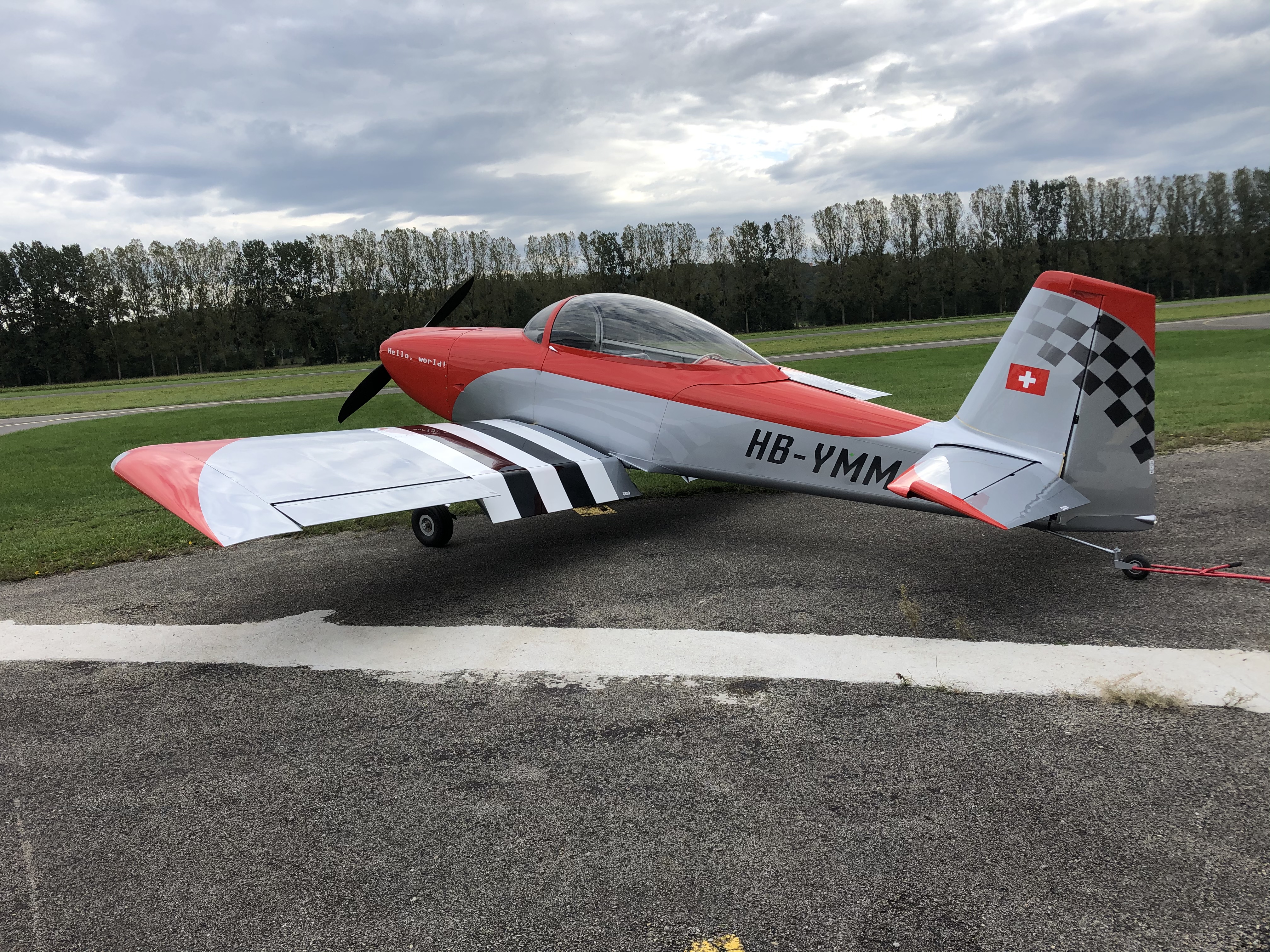
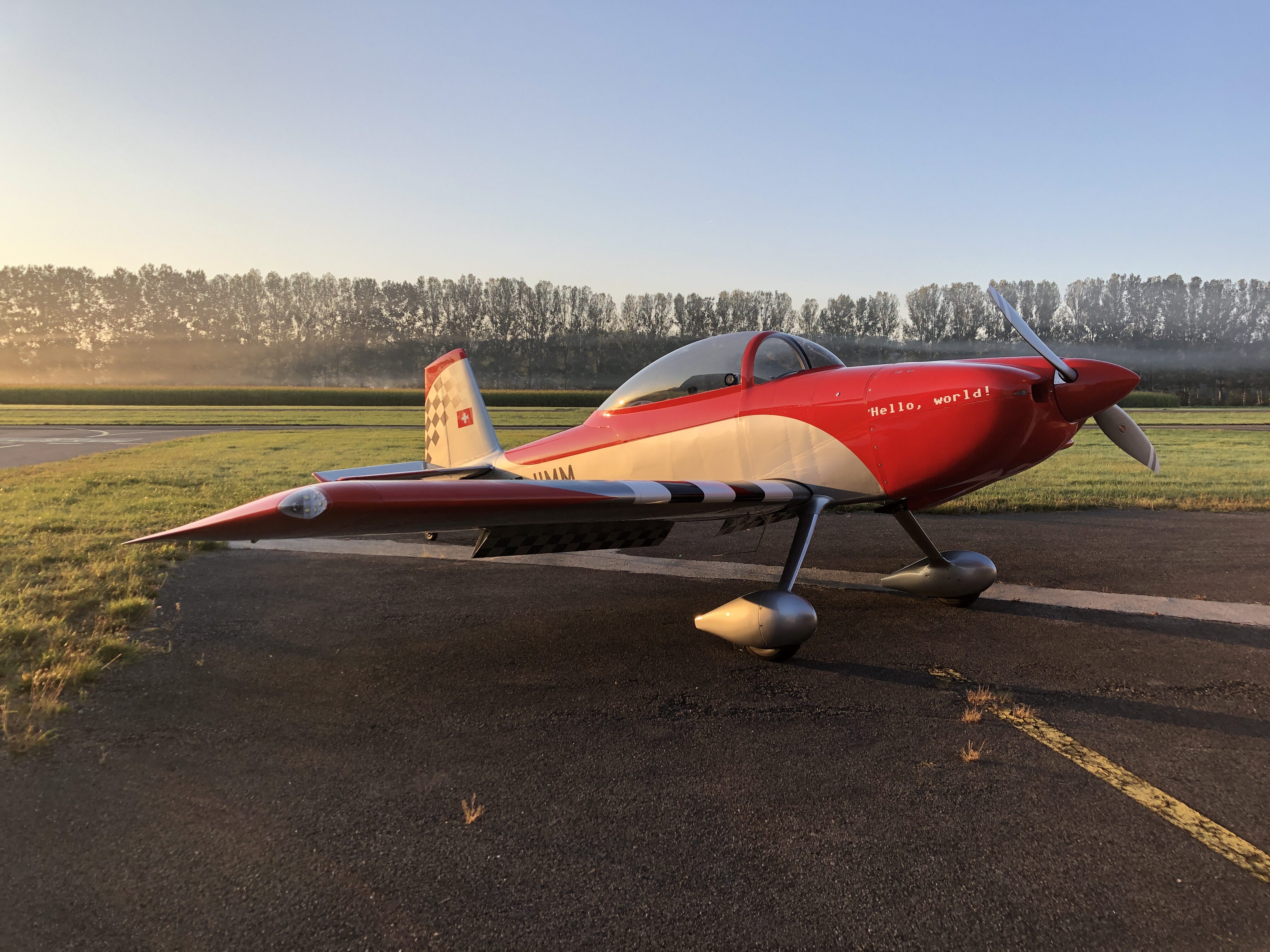
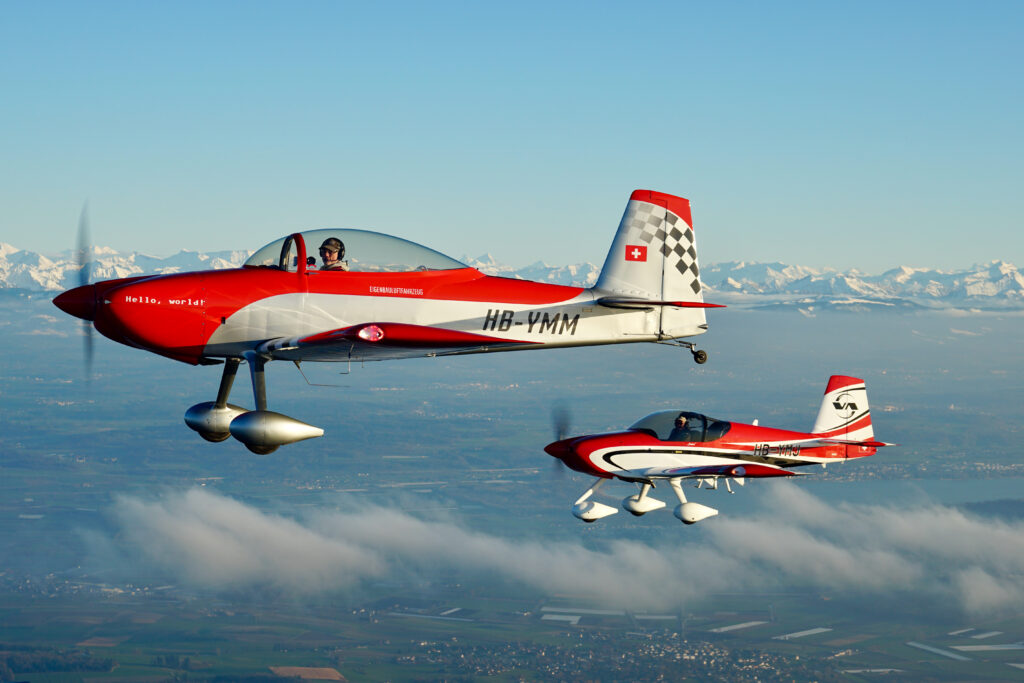

Welcome to RV8.ch! This little site will document the progress on the building of our Van's RV8 experimental aircraft. We will load lots of images, tips, tricks and techniques that we learn ourselves and from others on the net. Please visit the Photo Gallery!
A short introduction to the RV8 from Van's aircraft.
Danny King's "Beautiful Doll"
Information about Van's Aircraft RV8 can be found here. http://www.vansaircraft.com/public/rv-8int.htm I chose this plane because I want a tandem, not a side by side seating. Tandem allows the best visibility on either side of the aircraft. When I want to fly side by side, I can use one of our aeroclub's Pipers (http://www.aero-club.ch/)
I have decided to equip my plane with the following:
A Mattituck TMXIO-360 engine
MGL Odyssey
Garmin SL-40 VHF transceiver
Flightcom 403 stereo intercom
Trio Avionics EZ ProPilot autopilot
Tryg Mode-S Transponder (waiting for last minute updates)
Ameri-king AK-45 ELT - 406 MHz (waiting for price to drop)
Sun, Feb 20 2011 @ 19:07 in Switzerland
Contributed by: Mick
Views: 627
I picked up this brochure from Nelson Aerospace somewhere - can't recall where, but was interested to note that they seem to offer some kind of a "flareless" tube fitting. Looks interesting.
Sun, Feb 20 2011 @ 18:55 in Switzerland
Contributed by: Mick
Views: 936
These are the drawings that Van's provides for the control cables, but they include the caveat that you should check this for your engine before poking the holes.
Sun, Feb 20 2011 @ 18:42 in Switzerland
Contributed by: Mick
Views: 914
The fuel pump and filter are now installed and plumbed. I can't believe how long this took - most of the time was re-doing it because I didn't like the position or something else about how it was done. Not having clear instructions in the plans here means that there is a lot of design work, which takes time and trial and error.
I'm using the Andair fuel pump, but preferred to have a bigger fuel filter than the one that came with that kit. I had two of the Aeromotive fuel filters from the previous installation, and they are big, high flow, low pressure loss, 100 micro stainless steel filters. Really top quality.
I installed them so that it would be easy to clean the filter. The cap on the aft side will unscrew after removing the "U" between the outlet of the fuel filter and the inlet of the fuel pump. I tested to ensure that I can reach it from the baggage compartment - and I estimate that I will be able to do that. Not 100% sure since the top skin is not on nor the door, but it seems like it will work.
I still need to install the return line from the Airflow Performance "purge valve", which will be a -4 tube. It would be done but I'm missing one fitting, an AN816 which I need to order from Aircraft Spruce or Van's.
Sun, Jan 16 2011 @ 20:54 in Switzerland
Contributed by: Mick
Views: 915
Moving from the subaru engine to the lycoming I don't need two batteries, so I've rebuilt the battery rack in the tail for a the third, and hopefully final time.
It's much cleaner with only one battery, as you can imagine.
Here you can see the tray, which is made of one piece of 0.063" aluminum sheet with some angle to provide stiffness and make the frame to hold the battery.
The small fuse block on the left is for two circuits, both the front and back powerlet adapters (http://www.rv8.ch/article.php?story=20060712160534333) for phone charging, GPS power, etc. The reason I kept them "always hot" is to allow me to charge the battery using these ports. They are protected with a 10 amp fuse, and I have two spares in the fuse block.
Here is the standard "hand grenade" battery contactor. The connections to the battery are AWG 4 welding cable with nice connectors bought from B&C (http://www.bandc.biz/). The cable bringing the power to the front is a long AWG 2 welding cable. It's very flexible,and the case is very tough and flame resistant. Got it here: http://www.weldingtool.eu/
This top view shows the flush mounted torx screws that are used to attach the battery tray to the fuselage. I have four flush 10-32 flush screws, and 4 10-32 bolts. You can also see the ground bolt for the battery. I also attached this bolt to one of the longerons in the fuselage for extra ground, but I really doubt this will make any difference.
Here you can see two things that I added mainly for piece of mind. The first is the Adel clamp that helps route the right rudder cable so that it does not get hung on any of the wiring or the battery contactor. Also, I added a bit of delrin plastic on the mount near the battery contactor to protect the cable from any possible abrasion. Severe overkill here, but it will help me sleep better.
A few extra shots from different angles so that as much as possible is visible.
Sat, Dec 04 2010 @ 19:14 in Switzerland
Contributed by: Mick
Views: 875
The routing of the throttle, prop, and mixture cables is not really clearly documented that I could find. It was not too tricky, but it is important to get the holes in the aft part of the gear tower aligned up very closely with the bracket for the throttle, otherwise the cables will bind. This took a bit of playing around to get the exact templates, and in the end I decided to extend the bracket to include the holes, then drill through the gear tower. Worked fine.
Here is the view from aft:
Here is the forward part of the gear tower, with the holes. These holes do not necessarily need to line up exactly, since there is now space for the cables to bend a bit.
Sat, Dec 04 2010 @ 19:07 in Switzerland
Contributed by: Mick
Views: 1,026
I'm extremely happy that the new engine mount for the Lycoming engine fit perfectly on the firewall. I was very concerned about this aspect of replacing my Subaru engine with the Lycoming. All the holes matched up fine, and I could push the bolts in with my hands - no banging or hammering required!
Sun, Nov 21 2010 @ 21:34 in Switzerland
Contributed by: Mick
Views: 898
Van's includes a nice diagram of where things should go on the firewall. The location of the heater valve is shown clearly, but I am trying to determine if I can place it a bit to the right (left looking at the diagram, right when viewed from the cockpit) since I already have a large hole there that was used for my boost control cable.
Speaking of the heater valve, I bought a stainless steel valve from Avery Tools (http://www.averytools.com/) - just felt better to have this made out of stainless rather than the standard aluminum.