

Sun, Mar 18 2007 @ 18:30 in Switzerland
Contributed by: Mick
Views: 2,152
This is part two of the battery rack in the tail story. When I went to put in the baggage floors and sides, which go in front of and on top of the area where I put the battery, I was rather disappointed to find that my beautiful battery mounts were interfering with the forward vertical part of the baggage skins. It seems I have mounted my batteries too far forward. Ugh!
To fix it I needed to simply move the batteries back about 2 inches, so that's what I did. Here's what it looked like when I started:
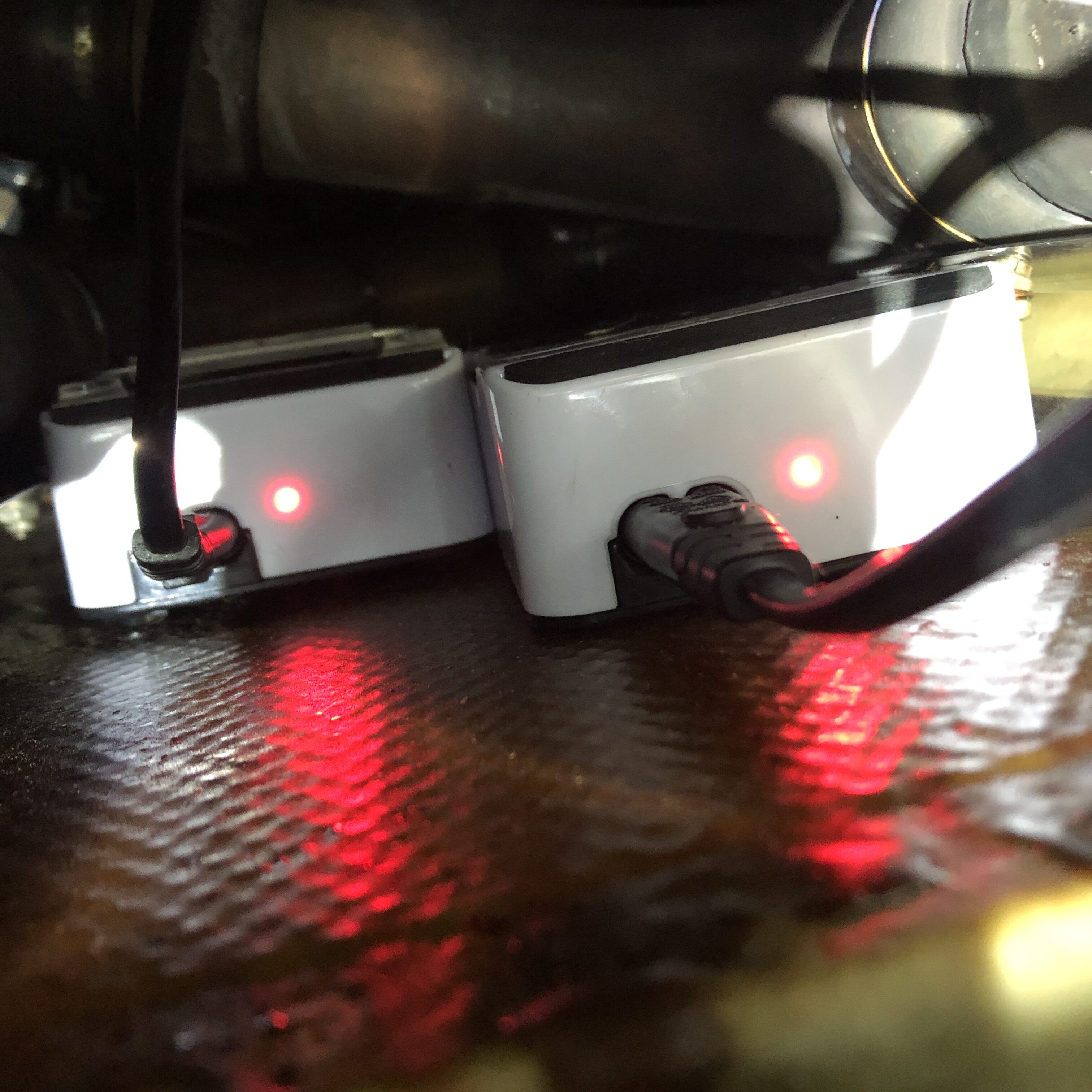
Here is the old battery rack with the new one. The green is the old one. I was able to reuse the angle for the new one. Notice that I've moved the battery contactors back.
Here is the final result. Several hours of work, and now the batteries are just a bit further back. That should help with C of G issues, at least.
I ordered a couple of standard "cigar lighter" connections to provide power for cell phones, ipods, and other portable devices, but I recently found a better system called "powerlet". http://www.powerletproducts.com/
These are used all over the motorcycle world, and are much better than the old cigar lighter connector.
Here is the connector installed in the right landing gear tower. This one is wired up to the left (standby) battery. It's wired direct so that I can charge the battery from this without turning on any switches. It's hooked up with a 5 amp fuse.
Here is the back of the connector, inside the gear tower.
Here is the connector for the passenger, installed on the right armrest, just under the headset jacks. I debated whether or not this is an ideal location, mainly since the hole is down, and crud could get in there. I decided this is a good place since it will be easy for the passenger to use and should not interfere with the arm. There may be better places, but I couldn't think of one.
This connector is hooked up to the right (main) battery with a 5 amp fuse.
Mon, Jun 26 2006 @ 22:48 in Switzerland
Contributed by: Mick
Views: 1,563
Here's what I want to do with the wig-wag module. I'd like to have an on/off switch for the landing lights on solid, and an on/off switch for the wig-wag. I want to just jumper the small connector to the ON position, then if I apply the power, the wig-wag will start. Is this reasonable?
Tue, May 23 2006 @ 19:49 in Switzerland
Contributed by: Mick
Views: 5,650
This is one of the most lucid descriptions of how an alternator works
that I have read. From one of the resident electricity wranglers on
the AeroElectric Connection Matronics List, Brian "Brain" Lloyd.
If you go back to an elementary science class, someone once told you
that if you wave a magnet around a wire, that wire will produce an
electric current. They also probably told you that if you pass a
current through a wire it will produce a magnetic field around the
wire. This was the amazing discovery of Michael Faraday and upon
which all electrical and radio theory is based.
Some alternators or generators do indeed use a permanent magnet
whirling around inside a coil of wire to produce power but the output
is directly proportional to how fast you spin it. If it makes more
output than you need you must find a way to get rid of the excess.
This is not a problem if the output is relatively small but if you
want something that can produce a lot of output for the times when
you need a lot of output, it produces way too much when you don't
need it all. Hence permanent magnet alternators, officially known as
"dynamos", tend to be small things.
But if you want one that can produce a lot of output when needed but
not much output when not needed you need a way to vary the
effectiveness. If you remember the two things that our buddy Mike
discovered, i.e. that moving magnetism generates an electric current
and moving electrons generate magnetism, you have the basic
components you need. If you want to increase the output of your
alternator at a given rotational velocity you need more magntism and
vice versa. So how can we turn the magnatism up and down as needed?
Why, we use a coil of wire with a current flowing through it. If we
increase the current, the magnetism increases and the output of our
alternator increases. If we reduce the current, the output of our
alternator decreases. This electromagnet is the rotating part of the
alternator. It is called the rotor but it is also called the field
winding from the olden days when we used generators.
A generator has the power-producing windings on the spinning part
called the armature and the magnetic field producing part, the field
windings, around the outside. An alternator has the magnetic field
windings on the spinning part (rotor) and the power-producing coils
(stator) are around the outside. You see I keep using the term
"magnetic field producing part" over again. That just got shortened
over time to the word "field".
So the way this whole thing works is to have an external sensor
determine if the alternator is producing as much power as needed. It
does this by measuring the voltage on the bus. If the voltage is too
low it allows more current to flow through the field winding. This
increases the magnetism in the center of the alternator and that then
induces more output in the stator winding. The voltage rises. If the
voltage gets higher than we want the VR reduces the current in the
field, the magnetic field is decreased, the output of the stator
windings is less, and the voltage at output is reduced. To me this
represents PFM (Pure f'n magic) and is also PFN (pretty f'n neat).
Thanks Mike!
Sat, May 20 2006 @ 18:03 in Switzerland
Contributed by: Mick
Views: 1,408
Question:
Where is the source for a 40" MB coax antenna? All I find in the Connection is a 75" length for a quarter wave balun.
Answer:
Antennas don't necessarily need to be resonant and/or efficient. If
you have a lot of signal you might not need a lot of antenna.
Consider that a marker beacon transmitter may run 50W of power or so
into a directional antenna beaming it straight up at your airplane.
Now consider that you need to receive it from only a couple thousand
feet away at most. It doesn't take a lot of antenna at the receiver
to pick up that signal.
Frankly, just about any piece of wire will suffice as a marker beacon
antenna.
So, take a piece of coax, strip the shield off of about 40" of it
(length is not critical) and connect the other end to your MB
receiver. Put the unshielded 40" or so where it might be able to see
the ground without too much shielding from the airframe. There is your
MB antenna.
Tue, Mar 07 2006 @ 09:45 in Switzerland
Contributed by: Mick
Views: 2,846
Now it's time to start wiring behind the panel. One of the most difficult steps is to figure out where to mount things. Once you've done that, the rest just sort of falls into place. Here is an article with a discussion of the electrical system design.
I've temporarily installed the switches on the panel. My short term goal here is to wire up enough stuff to start the engine. Once I've done that, and confirmed that all works fine, I'll finish up the rest. I still need to buy a radio and an EFIS.
A "before" view behind the panel.
Here are the two fuse blocks mounted. The right is the "normal" bus, and the left is the "essential" bus.
Another shot of the fuse blocks.
Here you can see the diodes for the ECU engine computer power. I've used two Perihelion Design Power Schottkys to create a little super-reliable bus. Discussion of this little bus can be found here: http://www.rv8.ch/article.php?story=20040406145425120
Top view. Also notice on the right another Power Schottky to provide separation between the normal bus and the essential bus.
Wed, Mar 01 2006 @ 21:56 in Switzerland
Contributed by: Mick
Views: 3,926
I mounted the forest of tabs ground onto the airframe. I ran one ground wire back to the batteries, and two ground wires from the engine to this single location. All the fat orange wire is AWG6 welding cable. It's very flexible and easy to work with. All grounds will come to this point, with the exception of some very small local grounds, like position lights.
Here you can see the engine grounds. I have two of them, just in case something happens to one. If the engine loses ground, it will stop running. Electricity is as important as fuel to this engine.
Here is another shot of the engine ground. You can also see the starter and its cables.
Here is the schematic of the grounding system:
Notice that I don't strictly follow the wise advice to have *everything* grounded to the same point. To do this with rear mounted batteries would require a lot more cables. So, I have a compromise, where just about everything grounds to the airframe at the same point, and is connected to the battery ground point with a fat cable. My overriding goal is to make sure that the engine computer and fuel pumps *never* stop. If these stop, the engine will not run.
I doubt that the fat cable from the single ground point in the cockpit back to the batteries is strictly needed. Many builders have reported that just grounding the batteries to the longeron in the back is sufficient.
Wed, Mar 01 2006 @ 13:51 in Switzerland
Contributed by: Mick
Views: 2,305
Here are a couple of quick photos of the contactor for the alternator and starter. I really don't need a starter contactor, but to simplify wiring, I've connected the alternator to the starter, and the starter to the contactor. There is a diagram here: http://www.rv8.ch/article.php?story=20041121101637759
In this picture you can also see the "forest of tabs" ground block. I will connect a ground wire to the back where the batteries are, and two ground wires to the engine. The engine ground is critical. If I lose that, I'll fall out of the sky.